Installation Guide
System Requirements
- Operating System: Windows 10+, macOS 10.15+, or Linux (Ubuntu 20.04+)
- Memory: 2GB RAM minimum (4GB recommended)
- Disk Space: 500MB free space
- Dependencies: Python 3.8+ (for runtime execution)
Download and Installation Steps
Windows
Phase 1: Downloading and Initializing Setup
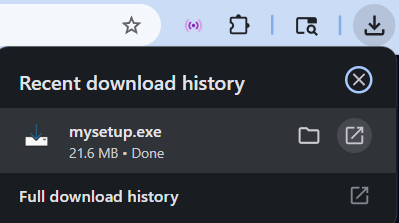
- Download the Installer: Visit the official download page hcl-111.pages.dev/download-language and click the Download HCL Language v1.0.0 button. Once the download is complete, you will see
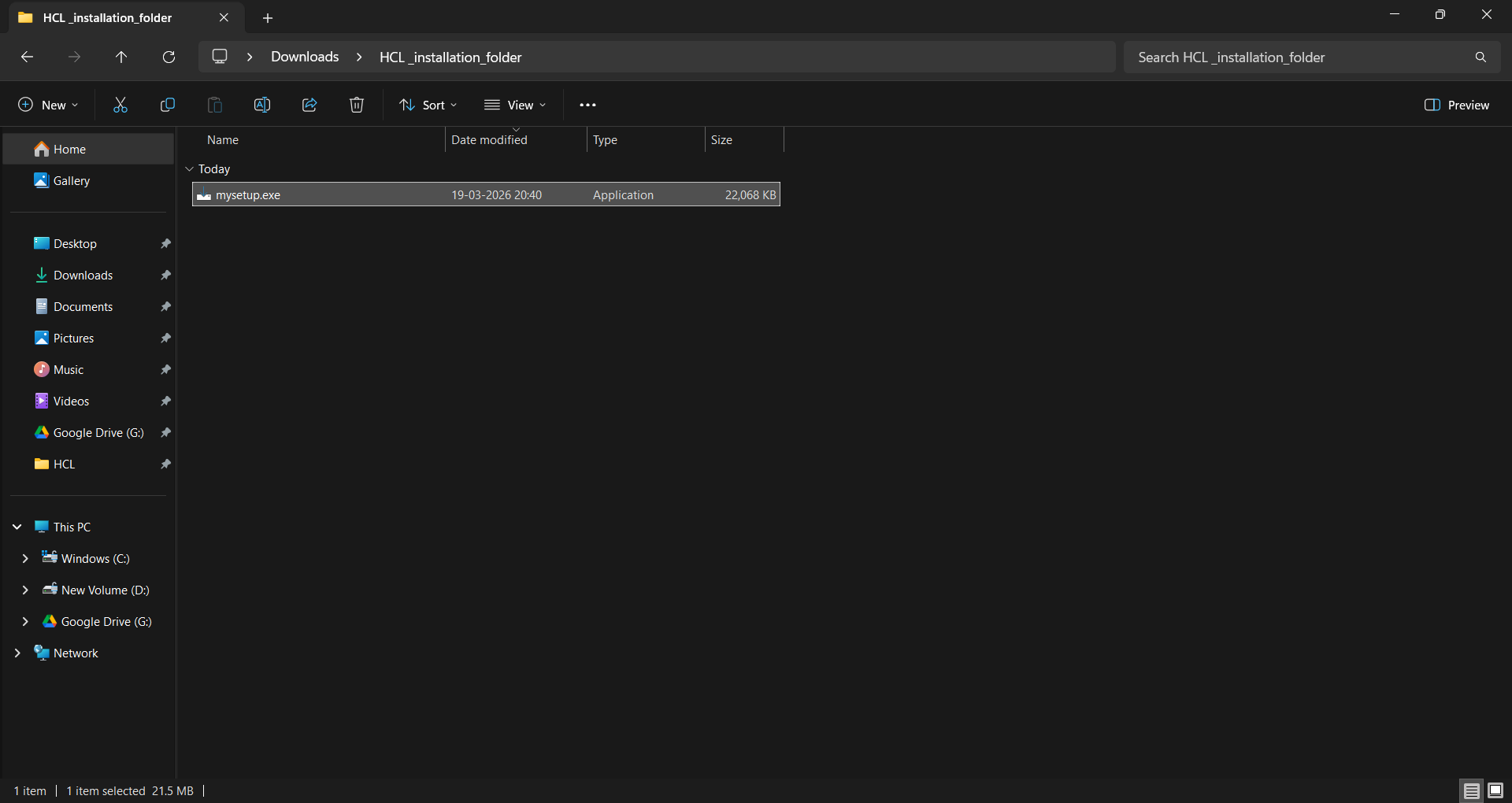
mysetup.exein your browser's download history. - Locate the File: Open your file explorer and navigate to the folder where the file was saved.
- Bypass Windows Security: If a "Windows protected your PC" warning appears, click on More info (if visible) and then select Run anyway to start the installation.
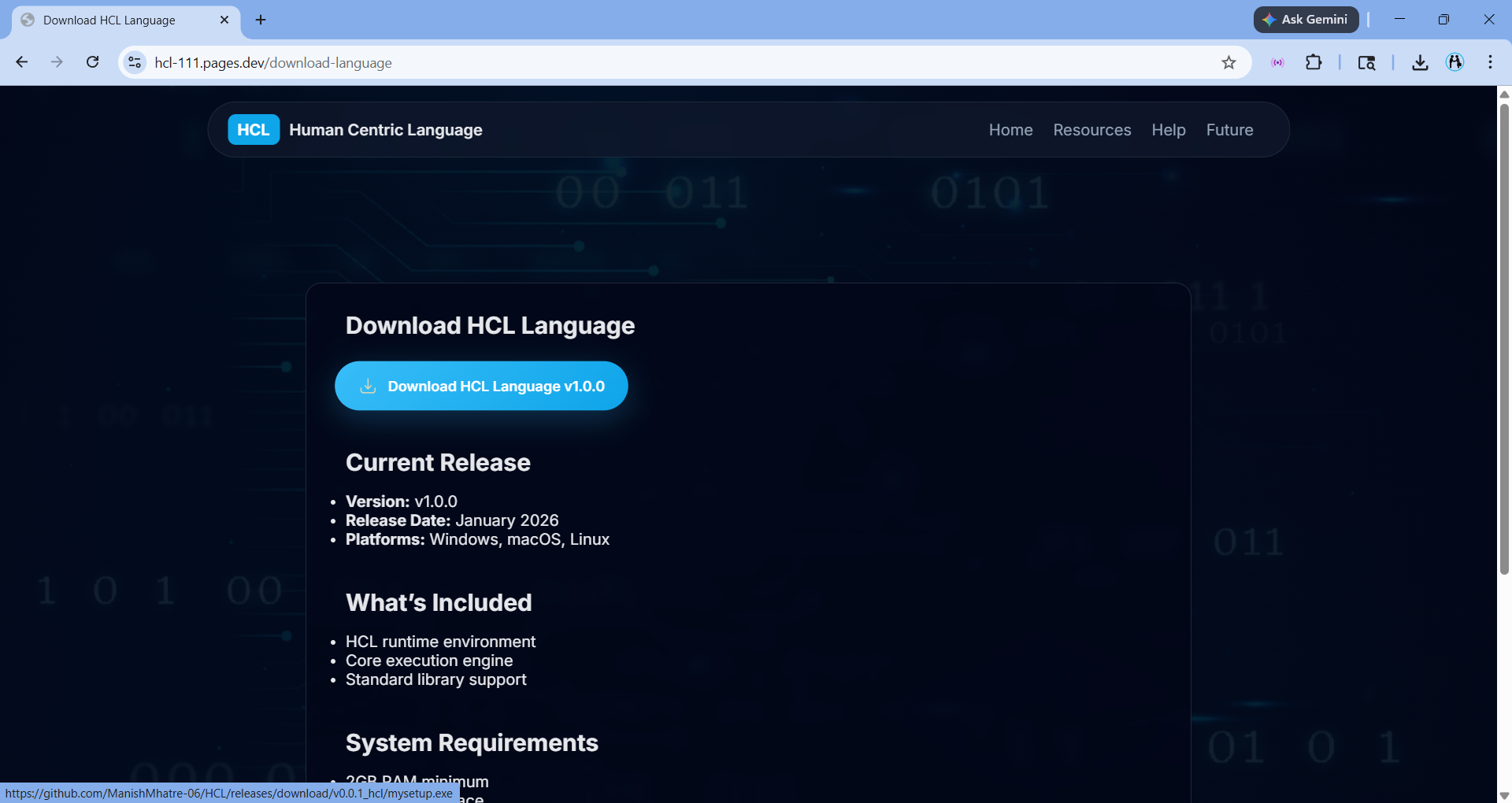

Phase 2: Installation Process
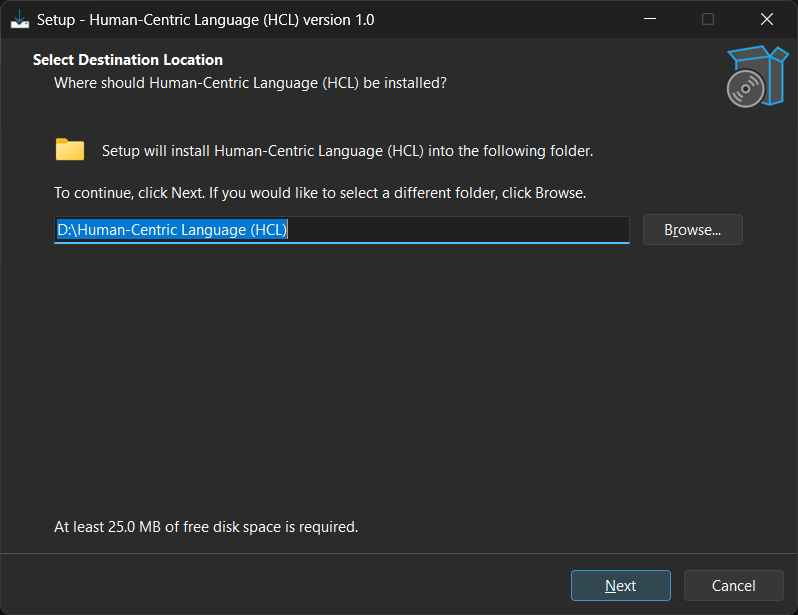
- Select Destination: Choose the folder where you want HCL to be installed. The default path is
D:\Human-Centric Language (HCL). Click Next. - Additional Tasks: Check the box for Create a desktop shortcut if you want quick access from your home screen. Click Next.
- Review and Install: Review your chosen settings. If everything looks correct, click Install.
- Finish Setup: Once the installation bar completes, ensure the Launch Human-Centric Language (HCL) box is checked and click Finish.
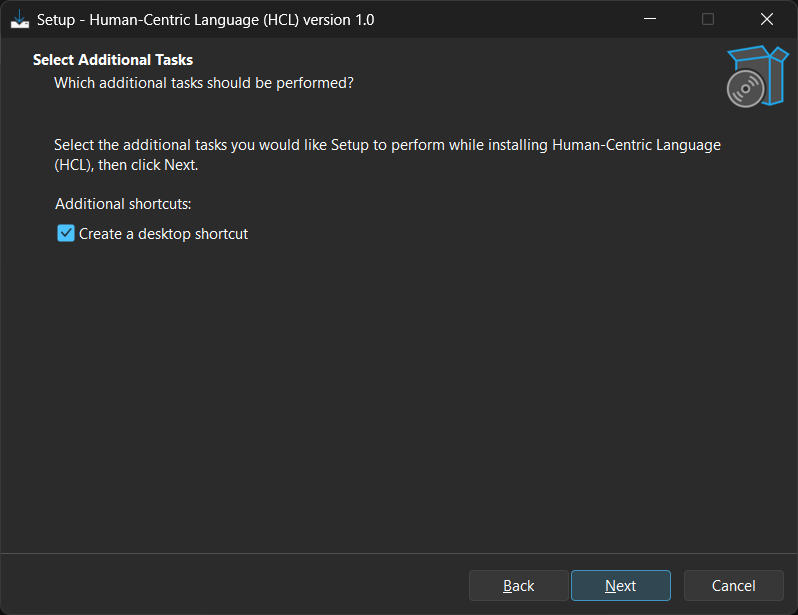
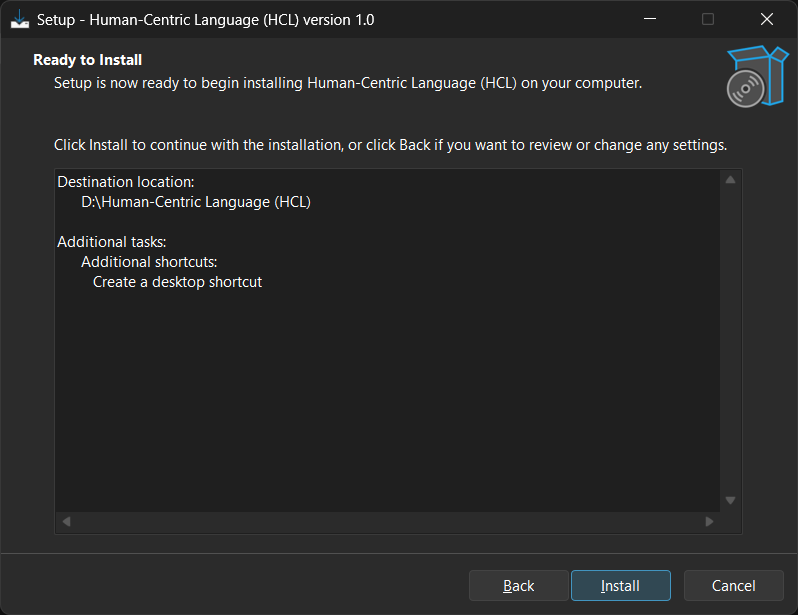
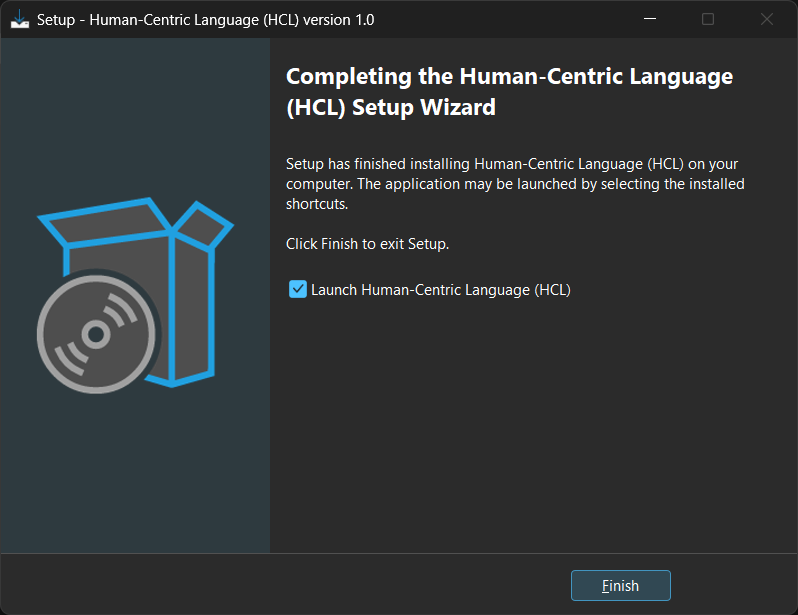
Phase 3: Launching the Terminal
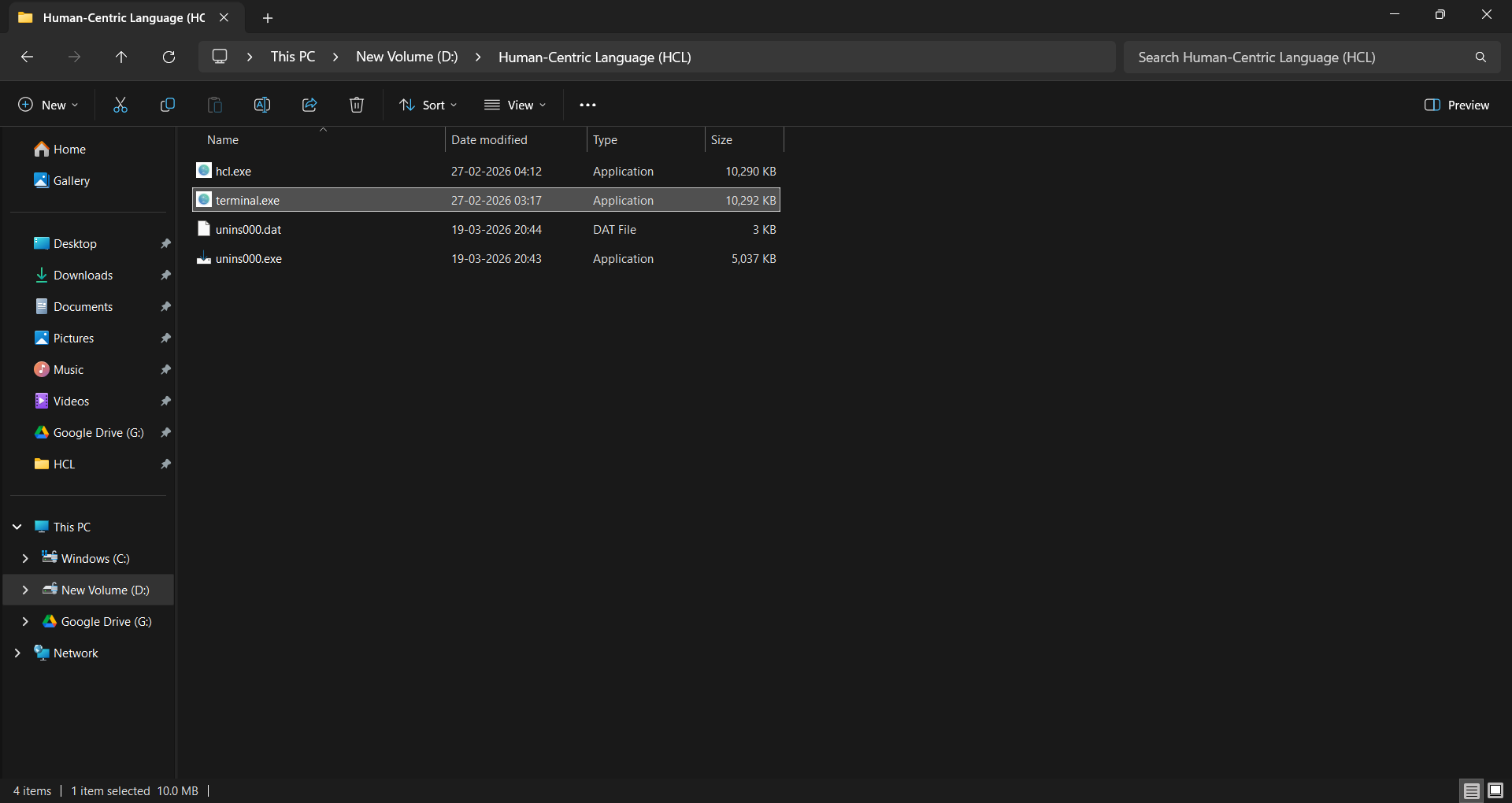
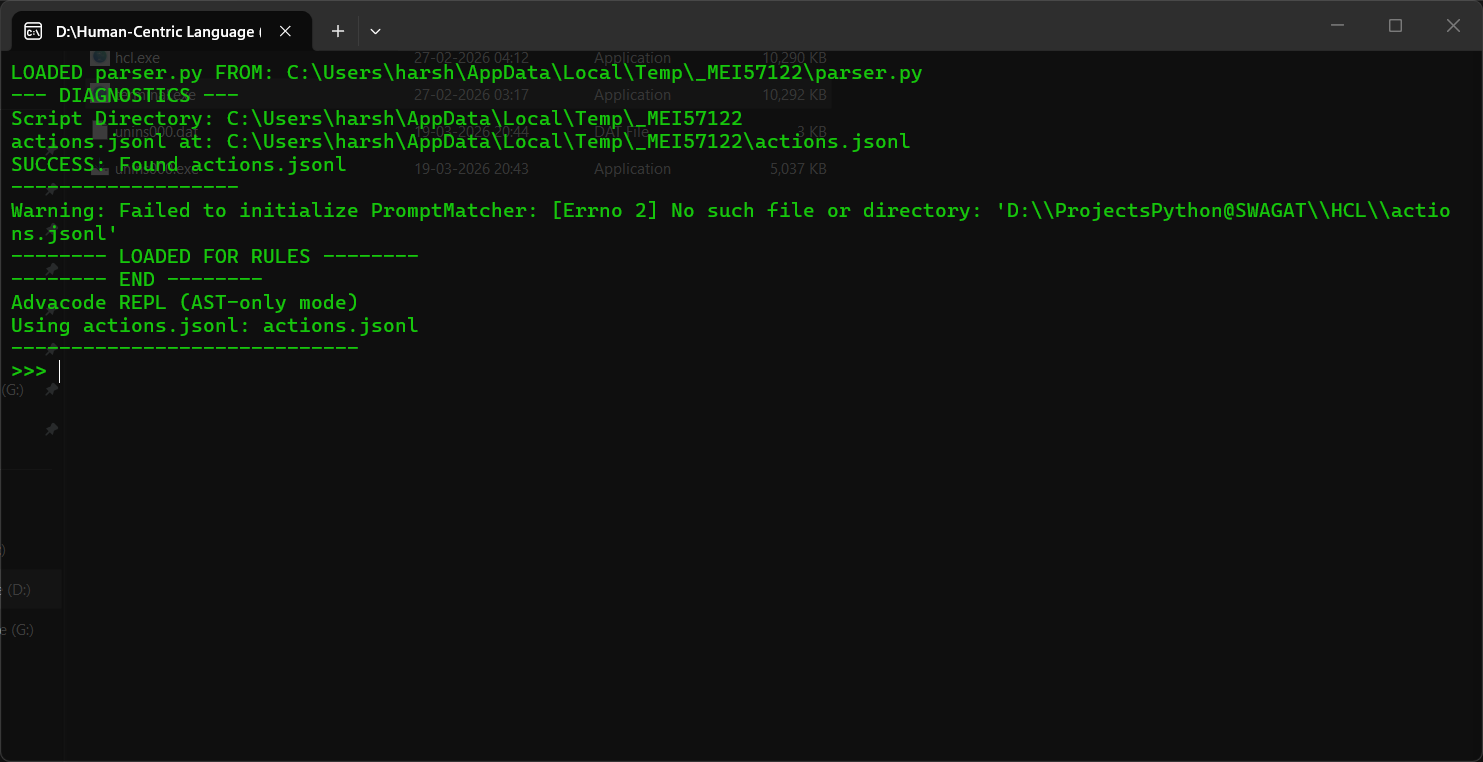
- Verify Installed Files: Navigate to your installation directory. You should see
hcl.exe,terminal.exe, and other system files likeactions.jsonlin the folder. - Run the REPL: Open
terminal.exe. A command-line interface will appear showing the diagnostic logs. Once the Advacode REPL (AST-only mode) initializes and you see the>>>prompt, the environment is ready for use.
Syntax & Code
How HCL Interprets Human Prompts
HCL uses natural language processing to convert human-readable instructions into executable code. The language is designed to be intuitive while maintaining precision.
# Basic printing
print "Hello World!"
display "Hello World!"
print "Hello World!" endprint

# Printing using variables
assign "Hello " to x
assign "World!" to y
print x plus y
User Input
get user input and store var1
get input and store var2
Assignment
# Single variable assignment
assign "Hello World!" to var1
make variable var2 equal to "Hello World!"
store "Hello World!" in var3

# Multiple variable assignment (explicit values)
create variables x, y, z and set them to "A", "B", "C"

# Multiple variable assignment (same value)
assign "A" to x, y, z
set x, y, z to "A"
make variables x, y, z equal to "A"
Data Types
# Checking data types
assign 34 to x
type of x

assign 3.14 to y
check type of y

assign "Johnny" to z
check type of z
Random Number
generate a random number between 1 and 10
Casting
# Casting numbers to string
assign 10 to a
convert a to string
assign convert a to string to b

# Casting string to integer
assign "123" to c
convert c to integer
assign convert c to integer to d

# Casting string to float
assign "3.14" to e
convert e to float
assign convert e to float to f

# Casting string to complex number
assign "5+2j" to g
convert g to complex number
assign convert g to complex number to h

# Casting string to list
assign "abc" to i
convert i to list
assign convert i to list to j

# Casting string to tuple
assign "12" to k
convert k to tuple
assign convert k to tuple to l

# Casting string to set
assign "123" to m
convert m to set
assign convert m to set to n

# Casting string to frozenset
assign "123" to o
convert o to frozenset
assign convert o to frozenset to p

# Casting string to boolean
assign "true" to q
convert q to boolean
assign convert q to boolean to r
String Methods
# Slicing and substring
assign "HelloWorld" to d
slice d from 1 to 4
assign slice d from 1 to 4 to a

# Whitespace handling
assign " spaced text " to g
strip whitespace from g
assign strip whitespace from g to b

# Joining and concatenation
assign "hello" to i
assign "world" to j
join string i with j
assign join string i with j to k

# Escaped characters
use escaped characters "line\nnew\ttext"
escape characters "path\to\file"

# Capitalization
assign "hello" to o
capitalize o
assign capitalize o to p

# Encoding
assign "encode_this" to r
encode r
assign encode r to s

# Ends with
assign "filename.txt" to t
check if t ends with ".txt"
assign check if t ends with ".txt" to u

# Expand tabs
expand tabs of "a\tb\tc"

# Alphanumeric check
check if "abc123" alphanumeric
assign check if "abc123" alphanumeric to a

# Alphabetic check
assign "HelloWorld" to v
check if v contains only letters
assign check if v contains only letters to w

# ASCII check
assign "A" to x
check if x ascii
assign check if x ascii to y

# Decimal / digit checks
assign "12345" to y
check if y decimal
assign check if y decimal to z

# Identifier validation
assign "valid_var" to ab
check if ab valid identifier
assign check if ab valid identifier to bc

# Lowercase checks
assign "lowercase" to ad
check if ad lowercase
assign check if ad lowercase to da

# Numeric checks
assign "123" to af
check if af numeric
assign check if af numeric to fa

# Printable characters
assign "Hello" to ah
check if ah printable
assign check if ah printable to ha

# Title case checks
assign "Hello World" to ak
check if ak title case
assign check if ak title case to ka

# Uppercase checks
assign "UPPER" to am
check if am uppercase
assign check if am uppercase to ma

# Join using delimiter
assign "abc" to ao
assign "-" to ap
join ao using ap
assign join ao using ap to op

# Case conversion
assign "SAMPLE" to as
convert as to lowercase
assign convert as to lowercase to sa

# Title case conversion
assign "hello world" to ay
convert ay to title case
assign convert ay to title case to ya

# Uppercase conversion
assign "final text" to ba
convert ba to uppercase
ssign convert ba to uppercase to ab

# String indexing
assign "HELLO" to s
character at index 1 from s
assign character at index 1 from s to u

# Negative indexing
assign "PYTHON" to w
character at negative index 2 from w
assign character at negative index 2 from w to v

# Count occurrences
assign "aaaaab" to s
count "a" in s
assign count "a" in s to t

# Index lookup
assign "abracadabra" to y
find "c" inside y
assign find "c" inside y to z

# String formatting
assign "Hello {}, I m {}" to f
format f using "Swagat", "HCL"
assign format f using "Swagat", "HCL" to a
Boolean Methods
assign 5 to x
evaluate boolean of x
Basic Arithmetic
# Addition
assign 5 to a
add a and 10
assign add a and 10 to b

# Subtraction
assign 3 to f
subtract 10 from f

# Multiplication
assign 6 to k
multiply k by 3
assign multiply k by 3 to l

# Division
assign 20 to p
divide p by 4
assign divide p by 4 to q

# Modulus
assign 17 to t
set remainder of t by 3

# Floor Division
assign 17 to c1
floor divide c1 by 3
assign floor divide c1 by 3 to c2
Full Arithmetic Operations
# Addition with assignment
assign 10 to g1
increase g1 by 5

# Subtraction with assignment
assign 20 to k1
subtract 5 from k1

# Multiplication with assignment
assign 3 to o1
multiplication with assign o1 by 4

# Division with assignment
assign 30 to r1
division with assign r1 by 5

# Modulus with assignment
assign 14 to u1
set remainder of u1 by 5

# Floor division with assignment
assign 20 to x1
floor division x1 by 3

# Power with assignment
assign 2 to a2
raise a2 to power 8

# Bitwise AND
assign 12 to d2
and operator bitwise d2 with 6

# Bitwise OR
assign 6 to h2
or operator bitwise h2 with 3

# Bitwise XOR
assign 7 to l2
xor operator bitwise l2 with 2

# Shift right
assign 16 to p2
shift p2 right by 2

# Shift left
assign 5 to t2
shift t2 left by 3

# Equality
assign 5 to x2
check if x2 equals 5
assign check if x2 equals 5 to x3

# Not equal
assign 10 to b3
check if b3 is not equal to 3
assign check if b3 is not equal to 3 to b4

# Greater than
assign 8 to e3
check if e3 is greater than 4
assign check if e3 is greater than 4 to e4

# Less than
assign 4 to h3
check if h3 is less than 9
assign check if h3 is less than 9 to h4

# Greater or equal
assign 10 to k3
check if k3 is greater than or equal to 9
assign check if k3 is greater than or equal to 9 to k4

# Less or equal
assign 5 to n3
check if n3 is less than or equal to 9
assign check if n3 is less than or equal to 9 to n4

# Logical AND
assign 1 to x3
assign 0 to y3
x3 and y3 only
assign x3 and y3 only to z3

# Logical OR
assign 1 to b4
assign 0 to c4
b4 or c4
assign b4 or c4 to d4

# Not / identity / membership
assign 5 to h4
assign 7 to i4
h4 is not i4
assign h4 is not i4 to j4

# Identity and membership (positive)
assign 5 to v4
assign 5 to w4
v4 is equal to w4
assign v4 is equal to w4 to x4
List Methods
# Setting list items
assign [10,20,30] to i
i[0] = 5

# List slicing (negative)
assign [1,2,3,4,5,6] to p
take negative slice p starting 5 from end until 2
assign take negative slice p starting 5 from end until 2 to q

# List slicing
assign [1,2,3,4,5] to t
slice list t from 1 to 4
assign slice list t from 1 to 4 to u

# List contains
assign ["apple","banana"] to x
"banana" in x
assign "banana" in x to y

# Extend list
assign [10,20] to e1
e1.extend([30,40])

# Sort list
assign [3,1,2] to k1
sort k1

# Pop last item
assign [1,2,3] to p1
pop from p1
assign pop from p1 to p2

# Join lists using plus
assign [1,2] to a2
assign [3,4] to b2
join a2 to b2 lists
assign join a2 to b2 lists to c2

# Append item
assign [1,2] to e2
append 3 to e2

# Extend list with another list
assign ["a"] to i2
join ["b","c"] into i2

# Create list using constructor
assign "abc" to k2
convert k2 to list

# Delete entire list
assign ["a","b"] to p2
remove list p2

# Sort list in descending order
assign [3,1,2] to r2
sortreverse r2 descending order

# Reverse list
assign [1,2,3] to v2
reverse v2

# Get item using negative index
assign [10, 20, 30, 40] to a
get item at negative index 1 from a
assign get item at negative index 1 from a to b

# Get item by index
assign [5, 6, 7, 8] to nums
get item at index 2 from nums
assign get item at index 2 from nums to val

# Append element
assign [1, 2, 3] to l
append 4 to l

# Get index of item
assign ["apple", "banana", "mango"] to fruits
get index of "banana" from fruits

# Count occurrences
assign [1, 2, 2, 2, 3] to nums
count 2 in nums
assign count 2 in nums to c
Tuple Methods
# Tuple slicing
assign (1,2,3,4,5) to g
tuple slice g from 1 to 4
assign tuple slice g from 1 to 4 to h

# Tuple slice from start
assign ("a","b","c","d") to j
tuple slice j till 2
assign tuple slice j till 2 to k

# Tuple slice to end
assign (1,2,3,4,5) to m
tuple slice m from 2
assign tuple slice m from 2 to n

# Tuple contains
assign (11,22,33) to r
22 in r
assign 22 in r to s

# Remove item from tuple via list
assign (10,20,30) to u
removing list 20 from tuple u
assign removing list 20 from tuple u to v

# Add tuple to tuple
assign ("a","b") to y
assign ("c","d") to z
join tuple y with z
assign join tuple y with z to x

# Multiply tuple
assign (1,2) to g1
repeat tuple g1 3 times
assign repeat tuple g1 3 times to g2

# Tuple type check
assign (1,2,3) to j1
check if j1 is it tuple
assign check if j1 is it tuple to j2

# Convert tuple to list
assign (1,2,3) to m1
conversion of tuple m1 to list
assign conversion of tuple m1 to list to m2

# Convert list to tuple
assign ["a","b"] to q1
change q1 to tuple
assign change q1 to tuple to q2

# Join tuples
assign (1,2) to s1
assign (3,4) to t1
join tuple s1 and t1
assign join tuple s1 and t1 to u1

# Get tuple item by index
assign (10, 20, 30, 40) to t
get item at index 2 from t
assign get item at index 2 from t to u

# Get tuple item using negative index
assign (5, 6, 7, 8) to a
get item at negative index 1 from a
assign get item at negative index 1 from a to b

# Add item to tuple via list
assign (10, 20, 30) to t
adding list [40] to tuple t
assign adding list [40] to tuple t to u

# Add single item to tuple
assign (1, 2, 3) to t
let tuple item 3 to t
assign let tuple item 3 to t to u

# Tuple unpacking (exact)
assign (10, 20, 30) to t
tuple t to variables x, y, z

# Count occurrences
assign ("apple", "chocolate", "apple", "banana", "apple") to grocery
count "apple" in grocery
assign count "apple" in grocery to count
Set and Frozenset Methods
# Set contains
assign {1,2,3} to a
check if 2 in set a
assign check if 2 in set a to b

# Set symmetric difference
assign {1,2,3} to c1
assign {3,4,5} to d1
symmetric difference of c1 and d1

# Set intersection
assign {1,2,3} to w
assign {2,3,4} to x
common items in w and x
assign common items in w and x to y

# Set difference
assign {1,2,3,4} to o1
assign {2,4} to p1
difference of o1 and p1

# Set difference update
assign {"a","b","c"} to w1
assign {"b"} to x1
difference update set w1 using x1

# Set intersection update
assign {"a","b","c"} to l2
assign {"b"} to m2
intersection update set l2 using m2

# Set is disjoint
assign {1,2,3} to p2
assign {4,5,6} to q2
check if set p2 disjoint with q2
assign check if set p2 disjoint with q2 to r2

# Set subset check
assign {1,2} to v2
assign {1,2,3} to w2
is set v2 contained in w2
assign is set v2 contained in w2 to x2

# Set symmetric difference update
assign {1,2} to t3
assign {2,3} to u3
update set t3 with symmetric difference of u3

# Union with assignment
assign {1,2} to z3
assign {2,3} to a4
combine all elements of set z3 and a4 to result

# Set update
assign {1} to d4
assign {1,2,3} to e4
merge set e4 into set d4

# Discard item from set
assign {10,20,30,40} to nums
discard 40 from set nums

# Set union
assign {1,2,3} to a
assign {3,4,5} to b
combine all elements of set a and b to c

# Create frozenset
assign [1,2,3] to j4
make frozenset from j4
assign make frozenset from j4 to j5

# Frozenset union
assign frozenset({1,2}) to n4
assign frozenset({2,3}) to o4
combine frozensets n4 and o4
assign combine frozensets n4 and o4 to m4

# Frozenset is disjoint
assign frozenset({"x"}) to n5
assign frozenset({"y"}) to o5
do frozensets n5 and o5 share no elements
assign do frozensets n5 and o5 share no elements to p5

# Frozenset subset check
assign frozenset({1}) to p5
assign frozenset({1,2}) to q5
is frozenset p5 contained in q5
assign is frozenset p5 contained in q5 to r5
Dictionaries
# Dictionary length
assign {"a":1,"b":2,"c":3} to g
length of g
assign length of g to h

# Dictionary type check
assign {"id":101,"name":"Sam"} to j
type of j

# Get item by key
assign {"name":"John","age":30} to m
get value for key "name" from dict m
assign get value for key "name" from dict m to n

# Get item safely
assign {"name":"Alice","country":"UK"} to p
get value for key "country" from dict p safely
assign get value for key "country" from dict p safely to q

# Check if key exists
assign {"user":"Tom","role":"admin"} to s
check if key "role" exists dict s
assign check if key "role" exists dict s to t

# Get dictionary keys
assign {"name":"Mia","age":22} to u
get all keys inside dict u
assign get all keys inside dict u to v

# Get dictionary values
assign {"name":"Mia","age":22} to x1
get all values inside dict x1
assign get all values inside dict x1 to y1

# Get dictionary items
assign {"name":"Mia","age":22} to a2
get items dict a2
assign get items dict a2 to b2

# Set item in dictionary
assign {"name":"John","age":25} to d2
set key "age" to 30 in dict d2

# Update dictionary
assign {"a":1,"b":2} to g2
assign {"c":3} to h2
update dict g2 with h2

# Set default value
assign {"a":1} to q2
set default value for key "b" in dict q2

# Pop key from dictionary
assign {"name":"John","age":30} to t2
pop key "age" from dict t2

# Delete key
assign {"name":"Tom","age":40} to z3
delete key "age" from dict z3

 # Delete dictionary
assign {"x":10} to d4
remove dict d4

# Clear dictionary
assign {"a":1,"b":2,"c":3} to f4
clear f4

# Copy dictionary
assign {"name":"Sam","age":21} to i4
make a copy of dict i4 to j4
Conditionals
# Conditional statements

assign 10 to x

if x > 10 then print "Greater than 10" endprint elif x == 10 then print "Equal to 10" endprint else print "Less than 10" endprint end-if


# Nested conditional statements

if 2 < 11 then assign {1,2,3} to c1; assign {3,4,5} to d1; symmetric difference of c1 and d1; assign {1,2,3} to w; assign {2,3,4} to x; assign common items in w and x to y elif 2 > 11 then assign {1,2,3} to w; assign {2,3,4} to x; assign common items in w and x to y; if 2 < 11 then assign {1,2,3} to c1; assign {3,4,5} to d1; symmetric difference of c1 and d1; assign {1,2,3} to w; assign {2,3,4} to x; assign common items in w and x to y elif 2 > 11 then assign {1,2,3} to w; assign {2,3,4} to x; assign common items in w and x to y; if 2 < 11 then assign {1,2,3} to c1; assign {3,4,5} to d1; symmetric difference of c1 and d1; assign {1,2,3} to w; assign {2,3,4} to x; assign common items in w and x to y elif 2 > 11 then assign {1,2,3} to w; assign {2,3,4} to x; assign common items in w and x to y else print "none" endprint end-if else print "none" endprint end-if else print "none" endprint end-if

# For loop inside conditional statement

assign 5 to x

if x > 3 then for i in range(3) then print "Looping running:", i endprint end for else print "Conditional false" endprint end-if

# While loop inside conditional statement

assign 2 to x

if x < 5 then assign 0 to i; while i < 3 then print "While loop:", i endprint; increase i by 1 end loop else print "Conditional false" endprint end-if

# Function inside conditional statements

assign 10 to x

if x > 5 then define function greet then print "Hello from function" endprint end function call greet else print "No Function Call" endprint end-if

# Class inside conditional statements

assign 1 to x

if x > 5 then class Person then make constructor for class Person with self, name then assign name to self.name end constructor; define function show with self then print "Name:", self.name endprint end function end class; create object p from class Person with parameters "Manish"; call method show on object p else print "No Function Call" endprint end-if
Loops
# For Loop

for i in [1,2,3] then print i endprint end for

assign [1,2,3] to x
for i in x then print i endprint end for

for i in "HELLO WORLD" then print i endprint end for


# Nested For Loop

for i in [1,2,3] then print i endprint; for i in "HELLO WORLD " then print i endprint end for end for

# Conditional statement inside for loop

for i in range(5) then if i % 2 == 0 then print i, "Even number" endprint else print i, "Odd number" endprint end-if end for

# For loop using break

for i in fruits then print i endprint; if i == "banana" then break end-if end for

# For loop using continue

for i in fruits then if i == "banana" then continue end-if print i end for

# While loop inside for loop

for i in range(3) then print "Outer loop:", i endprint; assign 0 to j; while j < 2 then print "  Inner while:", j endprint; increase j by 1 end loop end for

# Function inside for loop

for i in [1,2,3] then print i endprint; define function student then assign 2 to x; assign 3 to y; assign add x and y to z; for i in [1,2,3] then print i endprint end for end function end for

# Class inside for loop

for i in "HELLO WORLD" then print i endprint; class swag then assign {1,2,3} to c1; assign {3,4,5} to d1; symmetric difference of c1 and d1; class water then for i in [1,2,3] then print i end for end class end class end for


# While loop

assign 0 to i

while i < 5 then if i % 2 == 0 then print i, "Even number" endprint else print i, "Odd number" endprint end-if increase i by 1 end loop

# Nested while loop

assign 0 to i

while i < 3 then print "Outer loop:", i endprint; assign 0 to j; while j < 2 then print "    Inner while:", j endprint; increase j by 1 end loop increase i by 1 end loop

# Class inside while loop

assign 0 to i

while i < 2 then class car then make constructor for class car with self, num then assign num to self.num end constructor; define function show with self then print "Car number:", self.num endprint end function end class; create object c1 from class car with parameters i; call method show on object c1; increase i by 1 end loop


# function inside while loop

assign 0 to i

while i < 3 then define function square with num then return num*num end function print square(i) endprint; increase i by 1 end loop

# Conditional statement inside while loop

assign 0 to i

while i < 5 then if i % 2 == 0 then print i, "Even number" endprint else print i, "Odd number" endprint end-if increase i by 1 end loop

# For loop inside while loop

assign 0 to i

while i < 3 then print "While loop:", i endprint; for j in range(2) then print "   For loop:", j endprint end for increase i by 1 end loop
Functions
# Define Function

define function student then assign 2 to x; assign 3 to y; assign add x and y to z end function

# Function with Parameters

define function student with name, age, self then assign name to self.name; assign age to self.age; print name, age endprint end function

# Nested Function

define function student then assign 2 to x; assign 3 to y; assign add x and y to z; define function student then assign 2 to x; assign 3 to y; assign add x and y to z end function end function

# Conditional statements inside Function

define function student then assign 2 to x; assign 3 to y; assign add x and y to z; if 2 < 11 then assign {1,2,3} to c1; assign {3,4,5} to d1; symmetric difference of c1 and d1; assign {1,2,3} to w; assign {2,3,4} to x; assign common items in w and x to y elif 2 > 11 then assign {1,2,3} to w; assign {2,3,4} to x; assign common items in w and x to y; if 2 < 11 then assign {1,2,3} to c1; assign {3,4,5} to d1; symmetric difference of c1 and d1; assign {1,2,3} to w; assign {2,3,4} to x; assign common items in w and x to y elif 2 > 11 then assign {1,2,3} to w; assign {2,3,4} to x; assign common items in w and x to y; if 2 < 11 then assign {1,2,3} to c1; assign {3,4,5} to d1; symmetric difference of c1 and d1; assign {1,2,3} to w; assign {2,3,4} to x; assign common items in w and x to y elif 2 > 11 then assign {1,2,3} to w; assign {2,3,4} to x; assign common items in w and x to y else print "none" endprint end-if else print "none" endprint end-if else print "none" endprint end-if end function

# For loop inside Function

define function student then assign 2 to x; assign 3 to y; assign add x and y to z; for i in [1,2,3] then print i endprint end for end function

call student

# While loop inside Function

define function student then assign 2 to x; assign 3 to y; assign add x and y to z; while x < 10 then print x endprint; add 1 to x end loop end function

# Class inside Function

define function student then assign 2 to x; assign 3 to y; assign add x and y to z; class Person then assign {1,2,3} to c1; assign {3,4,5} to d1; symmetric difference of c1 and d1 end class end function
OOP - (Object Oriented Programming)
# create class and its object

class Person then assign {1,2,3} to c1; assign {3,4,5} to d1; symmetric difference of c1 and d1 end class


create object s1 from class swagat

# delete object

remove object s1

# Nested class

class person then assign {1,2,3} to c1; assign {3,4,5} to d1; symmetric difference of c1 and d1; class water then assign ("a","b") to y; assign ("c","d") to z; assign join tuple y with z to x; print x end class end class


# Nested class with neseted if else

class person then assign {1,2,3} to c1; assign {3,4,5} to d1; symmetric difference of c1 and d1; class water then class ssw then assign {1,2,3} to c1; assign {3,4,5} to d1; symmetric difference of c1 and d1; if 2 < 11 then assign {1,2,3} to c1; assign {3,4,5} to d1; symmetric difference of c1 and d1; assign {1,2,3} to w; assign {2,3,4} to x; assign common items in w and x to y elif 2 > 11 then assign {1,2,3} to w; assign {2,3,4} to x; assign common items in w and x to y; if 2 < 11 then assign {1,2,3} to c1; assign {3,4,5} to d1; symmetric difference of c1 and d1; assign {1,2,3} to w; assign {2,3,4} to x; assign common items in w and x to y elif 2 > 11 then assign {1,2,3} to w; assign {2,3,4} to x; assign common items in w and x to y; if 2 < 11 then assign {1,2,3} to c1; assign {3,4,5} to d1; symmetric difference of c1 and d1; assign {1,2,3} to w; assign {2,3,4} to x; assign common items in w and x to y elif 2 > 11 then assign {1,2,3} to w; assign {2,3,4} to x; assign common items in w and x to y else print "none" endprint end-if else print "none" endprint end-if else print "none" endprint end-if end class end class end class

# Nested class with nested for loop

class swag then assign {1,2,3} to c1; assign {3,4,5} to d1; symmetric difference of c1 and d1; class water then for i in [1,2,3] then print i end for end class end class


# inheritance

class swag then assign {1,2,3} to c1; assign {3,4,5} to d1; symmetric difference of c1 and d1 end class

define class gaot extends swag then print 2 endprint; class swami then assign {1,2,3} to c1; assign {3,4,5} to d1; symmetric difference of c1 and d1 end class end class

define class rock extends gaot then print "3rd class extends" endprint end class


# nested class


class person then assign {1,2,3} to c1; assign {3,4,5} to d1; symmetric difference of c1 and d1; class person then assign {1,2,3} to c1; assign {3,4,5} to d1; symmetric difference of c1 and d1; class swag then assign {1,2,3} to c1; assign {3,4,5} to d1; symmetric difference of c1 and d1 end class end class end class


class swagat then assign {1,2,3} to c1; assign {3,4,5} to d1; symmetric difference of c1 and d1; class swagat then assign {1,2,3} to c1; assign {3,4,5} to d1; symmetric difference of c1 and d1; class swagat then assign {1,2,3} to c1; assign {3,4,5} to d1; symmetric difference of c1 and d1 end class if 2 < 11 then assign {1,2,3} to c1; assign {3,4,5} to d1; symmetric difference of c1 and d1; assign {1,2,3} to w; assign {2,3,4} to x; assign common items in w and x to y elif 2 > 11 then assign {1,2,3} to w; assign {2,3,4} to x; assign common items in w and x to y; if 2 < 11 then assign {1,2,3} to c1; assign {3,4,5} to d1; symmetric difference of c1 and d1; assign {1,2,3} to w; assign {2,3,4} to x; assign common items in w and x to y elif 2 > 11 then assign {1,2,3} to w; assign {2,3,4} to x; assign common items in w and x to y; if 2 < 11 then assign {1,2,3} to c1; assign {3,4,5} to d1; symmetric difference of c1 and d1; assign {1,2,3} to w; assign {2,3,4} to x; assign common items in w and x to y elif 2 > 11 then assign {1,2,3} to w; assign {2,3,4} to x; assign common items in w and x to y else print "none" endprint end-if else print "none" endprint end-if else print "none" endprint end-if end class end class


# Constructor

class swagat then assign {1,2,3} to c1; assign {3,4,5} to d1; symmetric difference of c1 and d1; make constructor for class swagat with self then print 2 endprint end constructor end class


# __str__ method

class swag then  make constructor for class swagat with self then print 2 endprint end constructor define str function with self then print 3 end str end class


# abstraction (private/protected property)

class swag then  make constructor for class swagat with self then print 2 endprint end constructor define str function with self then print 3 end str define function crt with self then set private property x to 3; protected property y to 2 end function end class

# abstraction (private/protected function)

class swag then  make constructor for class swagat with self then print 2 endprint end constructor define str function with self then print 3 end str define function __cart with self then set private property x to 3; protected property y to 2 end function; define function _cold with self then set private property x to 3; protected property y to 2 end function end class


# Method call

class swag then  make constructor for class swagat with self then print 2 endprint end constructor define str function with self then print 3 end str define function __cart with self then set private property x to 3; protected property y to 2 end function define function _cold with self then set private property x to 3; protected property y to 2 end function define function friple then if 2 < 11 then assign {1,2,3} to c1; assign {3,4,5} to d1; symmetric difference of c1 and d1; assign {1,2,3} to w; assign {2,3,4} to x; assign common items in w and x to y elif 2 > 11 then assign {1,2,3} to w; assign {2,3,4} to x; assign common items in w and x to y; if 2 < 11 then assign {1,2,3} to c1; assign {3,4,5} to d1; symmetric difference of c1 and d1; assign {1,2,3} to w; assign {2,3,4} to x; assign common items in w and x to y elif 2 > 11 then assign {1,2,3} to w; assign {2,3,4} to x; assign common items in w and x to y; if 2 < 11 then assign {1,2,3} to c1; assign {3,4,5} to d1; symmetric difference of c1 and d1; assign {1,2,3} to w; assign {2,3,4} to x; assign common items in w and x to y elif 2 > 11 then assign {1,2,3} to w; assign {2,3,4} to x; assign common items in w and x to y else print "none" endprint end-if else print "none" endprint end-if else print "none" endprint end-if end function end class


create object w1 from class swag

call method friple on object w1
DSA - (Data Structures and Algorithms)
# Create Stack
create stack sk

# Push Element onto Stack
push 10 to stack sk

# Pop Element (Remove Top)
pop from stack sk

# Peek (View Top Element Without Removing)
peek stack sk

# Check if Stack is Empty (Boolean Result)
is stack sk empty

# Get Size of Stack
size of stack sk

# Assign Pop Result to Variable
assign pop from stack sk to x

# Assign Peek (Top Element) to Variable
assign peek stack sk to topVal

# Assign “Is Empty” Result to Variable
assign is stack sk empty to isEmpty

# Assign Stack Size to Variable
assign size of sk to man

# Create Queue
create queue q

# Enqueue Element (Add to Rear)
enqueue 10 to queue q

# Dequeue Element (Remove from Front)
dequeue from queue q

# Peek (View Front Element Without Removing)
peek queue q

# Check if Queue is Empty (Boolean Result)
is queue q empty

# Get Size of Queue
size of queue q

# Assign Dequeue Result to Variable
assign dequeue from queue q to x

# Assign Peek Element to Variable
assign peek queue q to frontVal

# Assign “Is Empty” Result to Variable
assign is queue q empty to isEmpty

# Assign Queue Size to Variable
assign size of q to sz

# Create Linked List
create linked list lnklist

# Insert at Beginning (Prepend)
insert 10 at beginning of linked list lnklist

# Insert at End (Append)
insert 20 at end of linked list lnklist

# Insert at Specific Index
insert 15 at index 1 in linked list lnklist

# Insert After a Given Node/Value
insert 25 after node 15 in linked list lnklist

# Insert Before a Given Node/Value
insert 12 before node 15 in linked list lnklist

# Delete from Beginning (Remove Head)
delete from beginning of linked list lnklist

# Delete from End (Remove Tail)
delete from end of linked list lnklist

# Delete Node by Value
remove 20 from linked list lnklist

# Delete Node at Specific Index
delete from index 1 in linked list lnklist

# Delete Node After a Given Node/Value
delete node after 12 in linked list lnklist

# Clear Entire Linked List
delete entire linked list lnklist

# Traverse / Display Linked List (Forward)
traverse linked list lnklist

# Traverse Backward (Reverse Display)
traverse backward linked list lnklist

# Update Value at Specific Index
update value at index 0 to 99 in linked list lnklist

# Update Node by Value
update node 20 to 200 in linked list lnklist

# Search Value and Store Position
search 200 in linked list lnklist and store in pos

# Get Node at Index and Store It
assign node at index 0 in linked list lnklist to nodeVal

# Assign Size / Length of Linked List
assign size of linked list lnklist to sz
assign length of linked list lnklist to sz

# Assign “Is Empty” Result to Variable
assign check linked list lnklist empty to isEmpty

# Reverse Linked List (Iterative)
reverse linked list lnklist

# Find Middle Element and Store It
assign middle element of linked list lnklist to midVal

# Find N-th Node from End and Store It
assign 3 th node from end of linked list lnklist to nthVal

# Merge Another Sorted Linked List
create linked list lnklist2
insert 20 at end of linked list lnklist2
merge lnklist2 into linked list lnklist

# Remove Duplicates from Linked List
remove duplicates from linked list lnklist

# Check if Linked List is Palindrome and Store Result
check if linked list lnklist is palindrome and store in isPal

# Create Hash Table
create hash table ht

# Put / Insert Key–Value Pair
put 100 into hash table ht at key 1

# Insert Only If Key Is Absent
insert 200 into hash table ht if key 2 is absent

# Assign Value of Key to Variable
assign value of key 1 in hash table ht to val1

# Safe Get with Default Value
assign safe get of key 5 from hash table ht with default 0 to val5

# Delete Key from Hash Table
delete key 1 from hash table ht

# Delete Key and Store Removed Value
delete key 2 from hash table ht and store in removedVal

# Clear Entire Hash Table
clear entire hash table ht

# Check if Key Exists and Store Result
assign does hash table ht contain key 1 to hasKey

# Check if Value Exists and Store Result
assign does hash table ht contain value 200 to hasVal

# Assign Size of Hash Table
assign size of hash table ht to sz

# Assign “Is Empty” Result to Variable
assign is hash table ht empty to isEmpty

# Assign Keys to Variable
assign keys of hash table ht to keysList

# Assign Values to Variable
assign values of hash table ht to valuesList

# Assign Key–Value Pairs to Variable
assign key-value pairs of hash table ht to pairsList

# Update Hash Table from Another Hash Table
create hash table ht2
put 400 into hash table ht2 at key 4
put 500 into hash table ht2 at key 5
update hash table ht from ht2

# Merge Two Hash Tables into a New One
merge hash table ht and ht2 into mergedHT

# Assign Shallow Copy of Hash Table
assign shallow copy of hash table ht to htCopy

# Assign Deep Copy of Hash Table
assign deep copy of hash table ht to htDeepCopy

# Assign Hash of a Value
assign hash of 100 to hashVal

# Assign Memory Size of Hash Table
assign memory size of hash table ht to memBytes

# Create Chained Hash Table with Capacity
create chained hash table ht with capacity 10

# Calculate Hash Index for Key with Capacity
calculate hash index for 25 with capacity 10 and store in idx

# Insert into Chained Hash Table
insert 300 at key 3 into chained hash table ht with capacity 10

# Get Value from Chained Hash Table and Store It
get value of key 3 from chained hash table ht with capacity 10 into val3

# Create Binary Tree with Root
create binary tree bt with root 50

# Create Empty Binary Tree
create empty binary tree bt

# Create Binary Tree from Array (Level-Order)
assign [1,2,4,5,3,7,6,8,9] to arr
create binary tree bt from array arr level-order
create binary tree btSub from array subarr level-order

# Clone Binary Tree
clone binary tree bt to btCopy

# Delete Leaf Node
delete leaf node 9 from binary tree bt

For your reference I have assign [1,2,4,5,3,7,6,8,9] to arr and to create binary tree bt and this is how it looks:


So, please generate delete leaf node user input again.

# Delete Node with One Child
delete node 5 with one child from binary tree bt

# Delete Node with Two Children
delete node 2 with two children from binary tree bt

# Delete Subtree at a Given Node
delete subtree at node 4 from binary tree bt

# Clear Entire Binary Tree
clear entire binary tree bt

# Insert Left Child
insert 10 as left child of 3 in binary tree bt

# Insert Right Child
insert 11 as right child of 3 in binary tree bt

# Insert at First Available Position (Level-Order Insert)
insert 12 at first available position in binary tree bt

# Delete Node from Generic Binary Tree
delete node 7 from generic binary tree bt

# Assign Inorder Traversal
assign inorder traversal of bt to inorderList

# Assign Preorder Traversal
assign preorder traversal of bt to preorderList

# Assign Postorder Traversal
assign postorder traversal of bt to postorderList

# Assign Level-Order Traversal
assign level order traversal of bt to levelOrderList

# Assign Reverse Level-Order Traversal
assign reverse level order traversal of binary tree bt to revLevelList

# Assign Zig-Zag (Spiral) Traversal
assign zig-zag traversal of binary tree bt to zigzagList

# Assign Root of Binary Tree
assign root of binary tree bt to rootVal

# Assign Parent of a Node
assign [1,2,4,5,3,7,6,8,9] to arr
create binary tree bt from array arr level-order
assign parent of node 3 in binary tree bt to parentVal

# Assign Left Child of a Node
assign [1,2,4,5,3,7,6,8,9] to arr
create binary tree bt from array arr level-order
insert 10 as left child of 3 in binary tree bt
assign left child of node 3 in binary tree bt to leftChildVal

# Assign Right Child of a Node
assign [1,2,4,5,3,7,6,8,9] to arr
create binary tree bt from array arr level-order
insert 11 as right child of 3 in binary tree bt
assign right child of node 3 in binary tree bt to rightChildVal

# Assign Sibling of a Node
assign sibling of node 3 in binary tree bt to siblingVal

# Assign Children of a Node
assign children of node 3 in binary tree bt to childrenList

# Assign Height of Binary Tree
assign height of binary tree bt to heightVal

# Assign Depth of a Node
assign depth of node 3 in binary tree bt to depthVal

# Assign Level of a Node
assign level of node 3 in binary tree bt to levelVal

# Assign Total Number of Nodes
assign total nodes of binary tree bt to totalNodes

# Assign Number of Leaf Nodes
assign leaf nodes of binary tree bt to leafCount

# Assign Number of Internal Nodes
assign internal nodes of binary tree bt to internalCount

# Assign Number of Full Nodes
assign full nodes of binary tree bt to fullCount

# Assign Width of Binary Tree
assign width of binary tree bt to widthVal

# Assign “Is Empty” Result
assign is binary tree bt empty to isEmpty

# Assign “Is Full” Binary Tree Result
assign is binary tree bt full to isFull

# Assign “Is Complete” Binary Tree Result
assign is binary tree bt complete to isComplete

# Assign “Is Perfect” Binary Tree Result
assign is binary tree bt perfect to isPerfect

# Assign “Is Balanced” Binary Tree Result
assign is binary tree bt balanced to isBalanced

# Assign “Is Symmetric” Binary Tree Result
assign is binary tree bt symmetric to isSymmetric

# Are Two Binary Trees Identical
assign are binary trees bt and bt2 identical to areIdentical

# Check if Value Is Present in Binary Tree
assign is value 7 present in binary tree bt to isPresent

# Assign Node with Given Value
assign node with value 7 in binary tree bt to node7

# Search Path to a Value
search for 7 in binary tree bt and assign path to path7

# Mirror Binary Tree
mirror binary tree bt

# Invert Binary Tree
invert binary tree bt

# Flatten Binary Tree to Linked List
flatten binary tree bt to linked list

# Convert Binary Tree to Doubly Linked List
convert binary tree bt to doubly linked list in dll

# Convert Binary Tree to Array (Level-Order)
convert binary tree bt to array level-order in arrBT

# Build Binary Tree from Preorder and Inorder Arrays
build binary tree btFromPreIn from preorder preorderList and inorder inorderList

# Build Binary Tree from Inorder and Postorder Arrays
build binary tree btFromInPost from inorder inorderList and postorder postorderList

# Lowest Common Ancestor (LCA)
assign lowest common ancestor of 8 and 9 in binary tree bt to lcaVal

# Diameter of Binary Tree
assign diameter of binary tree bt to diameterVal

# Maximum Path Sum
assign maximum path sum of binary tree bt to maxPathSum

# Check if One Tree Is a Subtree of Another
assign [5,8,9] to subarr
assign is binary tree btSub a subtree of bt to isSubtree

# Boundary Traversal of Binary Tree
assign boundary traversal of binary tree bt to boundaryList

# Vertical Order Traversal
assign vertical order traversal of binary tree bt to verticalList

# Top View of Binary Tree
assign top view of binary tree bt to topViewList

# Bottom View of Binary Tree
assign bottom view of binary tree bt to bottomViewList

# Left View of Binary Tree
assign left view of binary tree bt to leftViewList

# Right View of Binary Tree
assign right view of binary tree bt to rightViewList

# Distance Between Two Nodes
assign distance between 8 and 6 in binary tree bt to distVal

# Serialize Binary Tree to String
assign serialized string of binary tree bt to treeStr

# Deserialize Binary Tree from String
assign binary tree from string treeStr to btFromStr

# Serialize Binary Tree to Array
assign serialized array of binary tree bt to arrSerialized

# Persist Binary Tree to File
persist binary tree bt to file "tree_data.txt"

# Create Empty Binary Search Tree
create empty bst binSrhTree

# Create BST with Root Value
create bst binSrhTree with root 50

# Build BST from Array
assign [50, 30, 70, 20, 40, 60, 80] to bstArr
build bst binSrhTree from array bstArr


# Clone Binary Search Tree
clone bst binSrhTree to binSrhTreeCopy

# Insert Value into BST
insert 65 into bst binSrhTree

# Insert Multiple Values into BST
insert values [10, 35, 75] into bst binSrhTree

# Delete Value from BST
delete 30 from bst binSrhTree

# Search Node in BST
assign node 65 in bst binSrhTree to node65

# Assign Parent of a Value in BST
assign parent of 65 in bst binSrhTree to parent65

# Assign Path to a Value in BST
assign path to 65 in bst binSrhTree to path65

# Find Minimum Value in BST
assign min of bst binSrhTree to minVal

# Find Maximum Value in BST
assign max of bst binSrhTree to maxVal

# Delete Minimum Value from BST
delete min from bst binSrhTree

# Delete Maximum Value from BST
delete max from bst binSrhTree

# Find Inorder Successor
assign inorder successor of 65 in bst binSrhTree to successor65

# Find Inorder Predecessor
assign inorder predecessor of 65 in bst binSrhTree to predecessor65

# Check if Tree Is a Valid BST
check if binSrhTree is valid bst and assign to isValidBST

# Check if Tree Is Balanced
check if binSrhTree is balanced and assign to isBalancedBST

# Assign Height of Tree
assign height of binSrhTree to heightBST

# Assign Node Count of Tree
assign node count of binSrhTree to nodeCountBST

# Assign Leaf Count of Tree
assign leaf count of binSrhTree to leafCountBST

# Assign Internal Node Count of Tree
assign internal node count of binSrhTree to internalCountBST

# Lowest Common Ancestor (LCA) in BST
assign lca of 20 and 40 in bst binSrhTree to lcaBST

# K-th Smallest Element in BST
assign 3th smallest in bst binSrhTree to kthSmallestVal

# K-th Largest Element in BST
assign 2th largest in bst binSrhTree to kthLargestVal

# Range Search in BST
assign elements between 25 and 70 in bst binSrhTree to rangeVals

# Convert BST to Sorted Array
convert bst binSrhTree to sorted array sortedArr

# Build Balanced BST from Sorted Array
build balanced bst balancedBST from sorted array sortedArr

# Linear Search in First Occurrence
assign [12, 7, 25, 3, 18, 42, 9, 18, 30] to searchArr
find first occurrence of 18 in searchArr and store in idxFirst

# Linear Search in Last Occurrence
find last occurrence of 18 in searchArr and store in idxLast

# All Indices of a Value
find all indices of 18 in searchArr and store in idxAll

# Count Occurrences
find total count of 18 in searchArr and store in count18

# Contains (Existence Check)
check if searchArr contains 18 and store in has18

# First Condition
find first x in searchArr where x > 20 and store in firstGt20

# All Elements Matching Condition
find all x in searchArr where x > 20 and store in allGt20

# Count Matching Condition
find total x in searchArr satisfying x > 20 and assign to countGt20

# Case-Insensitive Search
search searchArr ignoring case for 18 and put index in ciIdx

# Range-Bounded Search
search 18 in searchArr from index 2 to 7 and store in rangeIdx

# Circular Search
circular search 18 in searchArr starting at 6 and store in circIdx

# Find Minimum
find minimum value in searchArr and store in minVal

# Find Maximum
find maximum value in searchArr and store in maxVal

# First Element Greater Than Value
find first element greater than 18 in searchArr and store in firstGt18

# First Element Less Than Value
find first element less than 18 in searchArr and store in firstLt18

# Nearest Match to Index
find occurrence of 18 in searchArr nearest to index 4 and store in nearIdx

# Exact Match in Binary Search
assign [3, 7, 9, 12, 18, 18, 25, 30, 42] to sortedArr
binary search 18 in sortedArr and store in bsIdx

# Recursive Binary Search
recursive binary search 18 in sortedArr and store in bsRecIdx

# Iterative
iterative binary search 18 in sortedArr and store in bsIterIdx

# Lower Bound
find lower bound of 18 in sortedArr and store in lbIdx

# Upper Bound
find upper bound of 18 in sortedArr and store in ubIdx

# First Occurrence
binary search first occurrence of 18 in sortedArr and store in firstBsIdx

# Last Occurrence
binary search last occurrence of 18 in sortedArr and store in lastBsIdx

# Count Occurrences
binary search count of 18 in sortedArr and store in bsCount18

# Search Insert Position
find search insert position of 20 in sortedArr and store in insPos20

# First Element Satisfying Condition
binary search first where x >= 18 in sortedArr and store in firstCondIdx

# Last Element Satisfying Condition
binary search last where x <= 18 in sortedArr and store in lastCondIdx

# Rotated Array Search
assign [18, 25, 30, 42, 3, 7, 9, 12, 18] to rotatedArr
search 18 in rotated array rotatedArr and store in rotIdx

# Find Pivot Index (Rotated Array)
binary search pivot of rotatedArr and assign to pivotIdx

# Minimum in Rotated Array
find minimum in rotated array rotatedArr and store in rotMinVal

# Exponential Search — Exact Match
exponential search 30 in sortedArr and store in expIdx

# Minimum Feasible Value
binary search min answer where x * x >= 200 between 0 and 50 and store in minAns

# Maximum Feasible Value
binary search max answer where x * x <= 200 between 0 and 50 and store in maxAns

# Strictly Sorted Matrix
assign [[3, 7, 9], [12, 18, 25], [30, 42, 55]] to strictMat
binary search 25 in strictly sorted matrix strictMat and store in matIdx

# Row-Wise Sorted Matrix
assign [[3, 7, 9], [12, 18, 25], [30, 42, 55]] to rowMat
search 18 in row-wise sorted matrix rowMat and store in matPos

# Bubble Sort
assign [29, 10, 14, 37, 13, 14, 5, 42, 8] to sortArr
standard bubble sort sortArr

# Optimized Bubble Sort
optimized bubble sort sortArr

# Recursive
recursive bubble sort sortArr

# Ascending Order
ascending bubble sort sortArr

# Descending Order
descending bubble sort sortArr

# Ascending Order in Selection Sort
assign [29, 10, 14, 37, 13, 14, 5, 42, 8] to sortArr
selection sort sortArr

# Descending Order
descending selection sort sortArr

# Stable Variant
stable selection sort sortArr

# Recursive
recursive selection sort sortArr

# Double (Bidirectional)
double selection sort sortArr

# Partial Range
selection sort sortArr from 2 to 6

# Ascending Order in Insertion Sort
assign [29, 10, 14, 37, 13, 14, 5, 42, 8] to sortArr
insertion sort sortArr

# Descending Order
descending insertion sort sortArr

# Binary Insertion Variant
binary insertion sort sortArr

# Recursive
recursive insertion sort sortArr

# Partial Range
insertion sort sortArr from 1 to 7

# Recursive (Standard) in Quick Sort
assign [29, 10, 14, 37, 13, 14, 5, 42, 8] to sortArr
quick sort sortArr

# First Element as Pivot
quick sort sortArr using first pivot

# Random Pivot
randomized quick sort sortArr

# Median-of-Three Pivot
quick sort sortArr using median of three

# Descending Order
descending quick sort sortArr

# Stable Variant
stable quick sort sortArr

# Stable Counting Sort
assign [4, 2, 7, 3, 2, 9, 1, 5, 3] to countArr
stable counting sort countArr

# General Counting Sort
sort countArr using counting sort

# With Explicit Range
counting sort countArr with range 1 to 9

# Descending Order
counting sort countArr descending

# Subarray Range
counting sort countArr from index 2 to 7

# Base-10 (Standard) Radix Sort
assign [4, 2, 7, 3, 2, 9, 1, 5, 3] to countArr
radix sort countArr

# LSD Radix Sort
lsd radix sort countArr

# MSD Radix Sort
msd radix sort countArr

# Signed Integers (With Negatives)
assign [4, -2, 7, -3, 0, 5, -1, 9] to signedArr
signed radix sort signedArr

# Strings (Lexicographical)
assign ["cat", "apple", "bat", "dog", "ant"] to strArr
string radix sort strArr

# Custom Base
radix sort countArr base 2

# Binary / Bitwise
binary radix sort countArr

# Bucket Variant
bucket radix sort countArr

# In-Place / Binary Exchange
inplace radix sort countArr

# Bottom-Up (Iterative) Merge Sort
assign [29, 10, 14, 37, 13, 14, 5, 42, 8] to sortArr
bottom up merge sort sortArr

# In-Place
inplace merge sort sortArr

# Stable
stable merge sort sortArr

# Descending Order
descending merge sort sortArr
Examples
Prime Number Checking
get user input and store n

assign 1 to is_prime

if n <= 1 then print "Not a prime number" else assign 2 to i; while i < n then if n % i == 0 then assign 0 to is_prime; break end if; add 1 to i end loop; if is_prime == 1 then print "Prime number" else print "Not a prime number" end if end if
Factorial Calculator
get user input and store n

assign 1 to fact
assign 1 to i

while i <= n then multiplication with assign fact by i; add 1 to i end loop; print fact
Fibonacci Sequence
get user input and store n

assign 0 to a
assign 1 to b
assign 1 to i

while i <= n then print a; assign a + b to c; assign b to a; assign c to b; add 1 to i end loop
Arithmetic Operations
    assign 10 to a
    assign 5 to b

    add a and b, store in sum
    subtract b from a, store in difference
    multiply a by b, store in product
    divide a by b, store in quotient

    print sum        # Output: 15
    print difference # Output: 5
    print product    # Output: 50
    print quotient   # Output: 2
Working with Variables
    set name to "John Doe"
    set age to 25
    set is_student to true

    print "Name: " + name
    print "Age: " + age
    print "Student: " + is_student
Control Flow
    assign 85 to score

    if score >= 90 then
      print "Grade: A"
    else if score >= 80 then
      print "Grade: B"
    else if score >= 70 then
      print "Grade: C"
    else
      print "Grade: F"
Lists and Collections
    create list with 1, 2, 3, 4, 5 and store as numbers
    add 6 to numbers
    print numbers  # Output: [1, 2, 3, 4, 5, 6]

    for each num in numbers
      print num
Dictionaries
    create dictionary as person
    set person["name"] to "Alice"
    set person["age"] to 30
    set person["city"] to "New York"

    print person["name"]  # Output: Alice
Simple Project: Temperature Converter
    # Temperature Converter
    print "Enter temperature in Celsius:"
    get input and store as celsius

    # Convert to Fahrenheit
    multiply celsius by 9/5
    add 32 to result
    store result as fahrenheit

    print "Temperature in Fahrenheit: " + fahrenheit
Frequently Asked Questions
What is HCL?
Human Centric Language (HCL) is a high-level instruction language that bridges the gap between human natural language and programming languages. It allows developers to write code using intuitive, human-readable syntax
How is NLP used in HCL?
HCL uses Natural Language Processing (NLP) techniques to parse and understand human-like instructions. The compiler employs:
- Tokenization: Breaking down instructions into meaningful tokens
- Pattern Matching: Identifying common programming patterns from natural language
- Semantic Analysis: Understanding the intent behind instructions
- Context-Aware Parsing: Maintaining state and context across statements
However, HCL maintains deterministic behavior — the same instruction always produces the same code, unlike AI-based code generators.
Is HCL open-source?
Yes! HCL is fully open-source under the MIT License. You can:
- View the source code on GitHub
- Contribute to the project
- Use it in commercial projects
- Submit issues and feature requests
Repository: github.com/ManishMhatre-06/HCL
Can I use HCL in production?
Yes! HCL is production-ready. Many companies use it for:
- Rapid prototyping
- Teaching programming concepts
- Internal tooling
- Domain-specific languages (DSLs)
How does HCL compare to other languages?
| Feature | HCL | Python | C++ |
|---|---|---|---|
| Readability | ★★★★★ | ★★★★☆ | ★★★☆☆ |
| Performance | ★★★★★ (depends on target) | ★★★☆☆ | ★★★★★ |
| Learning Curve | ★★★★★ | ★★★★☆ | ★★☆☆☆ |
| Cross-platform | ★★★★★ | ★★★★☆ | ★★★☆☆ |
What are the limitations of HCL?
- Not suitable for extremely low-level system programming
- Limited third-party library support (depends on target language)
- Some advanced features may not translate perfectly across all target languages
How do I contribute to HCL?
We welcome contributions! Here’s how to get started:
- Fork the repository on GitHub
- Create a feature branch (
git checkout -b feature/amazing-feature) - Make your changes and write tests
- Commit your changes (
git commit -m "Add amazing feature") - Push to the branch (
git push origin feature/amazing-feature) - Open a Pull Request
Where can I get help?
- Documentation: This guide covers most use cases
- GitHub Issues: Report bugs or request features
- Community Forum: Ask questions and share projects
- Discord Server: Real-time chat with other developers
- Stack Overflow: Tag your questions with
[hcl-lang]
Release Notes
Version 1.0.0 – January 15, 2026
Latest Stable ReleaseNew Features
- 🎉 Official 1.0 release – production ready!
- 📦 OOP and DSA integration
- 🧠 Advanced AST transformations
Improvements
- Better error messages
- Improved type inference system
- Optimized memory usage
Bug Fixes
- Fixed loop variable scoping issues
- Resolved Windows path handling bugs
- Addressed edge cases in pattern matching
Version 0.9.0 – December 1, 2025
New Features
- Interactive REPL mode
- Debug mode for auto-recompilation
Breaking Changes
- Changed
storekeyword toassignfor consistency
Version 0.8.0 – October 15, 2025
New Features
- Async/await syntax
- Built-in testing framework
- Documentation generator
Version 0.7.0 – September 1, 2025
New Features
- Module system and imports
- Standard library (file I/O, GUI, etc.)
- Debug mode and profiling tools
Version 0.6.0 – July 20, 2025
New Features
- Function definitions and calls
- Basic type system
Version 0.5.0 – June 1, 2025
New Features
- Python code generation (stable)
- Basic syntax and grammar
Upcoming Features (Roadmap)
Version 1.1.0 (Q2 2026)
- AI-assisted code suggestions
- Web-based playground
- Mobile app support (React Native / Flutter output)
Version 1.2.0 (Q3 2026)
- GPU/CUDA support
- Machine learning primitives
- Cloud deployment integration